
Driveway Paving in Belmont, MA
Your driveway has failed, or the house has none and you need a surface put in. Either way, on a Belmont lot you are probably dealing with a slope, a tight frontage, or both. Those two things decide how the job is done and what it costs.
Driveway Specialists is a family-run paving and hardscape contractor, working since 1988. We have spent more than 35 years paving across Middlesex, Norfolk and eastern Worcester counties.

What Our Clients Say
What happens when you call
We come and look at the site. We do not quote firm over the phone, because the things that set the price cannot be seen from a description.
On the visit we walk the drive from the street to wherever it ends. We measure the area. We look at how water moves across it, where it leaves, and where it collects. We check the edges, the existing surface, and what the drive meets at the bottom, whether that is a sidewalk, a curb cut or a garage door.
You get a written scope based on what we found. If the drive needs less than you feared, we say so. If the problem is underneath, we show you.
Why the base decides everything
Asphalt is only the top of the drive. The crushed stone beneath it carries the load and drains the water, and when that layer fails the surface fails with it. A new surface over a bad base looks good for a short time and then follows the base down.
Water is what wrecks a base. In New England it gets into the stone, freezes, and expands. The ground heaves, then settles unevenly when it thaws. Over repeated winters the surface cracks along the line of the movement, and edges break away where there is least support. A base that drains freely gives the water somewhere to go before it freezes. A base that holds water pushes the surface up and lets it drop, year after year.
A hillside lot makes this more demanding. Water runs down a slope, and a sloped driveway is a channel for it. If the drive has no way to shed that water to the side or away from the house, it
runs along the surface and soaks into the edges and the base. We look at where the water comes from above the drive as well as what falls on the drive itself.
Where the drive pitches toward a garage or a basement wall, drainage becomes the first problem and paving is second. The grade, the base and the surface need to be planned together. Fixing the surface alone leaves water heading for the same place.
Replacement or overlay
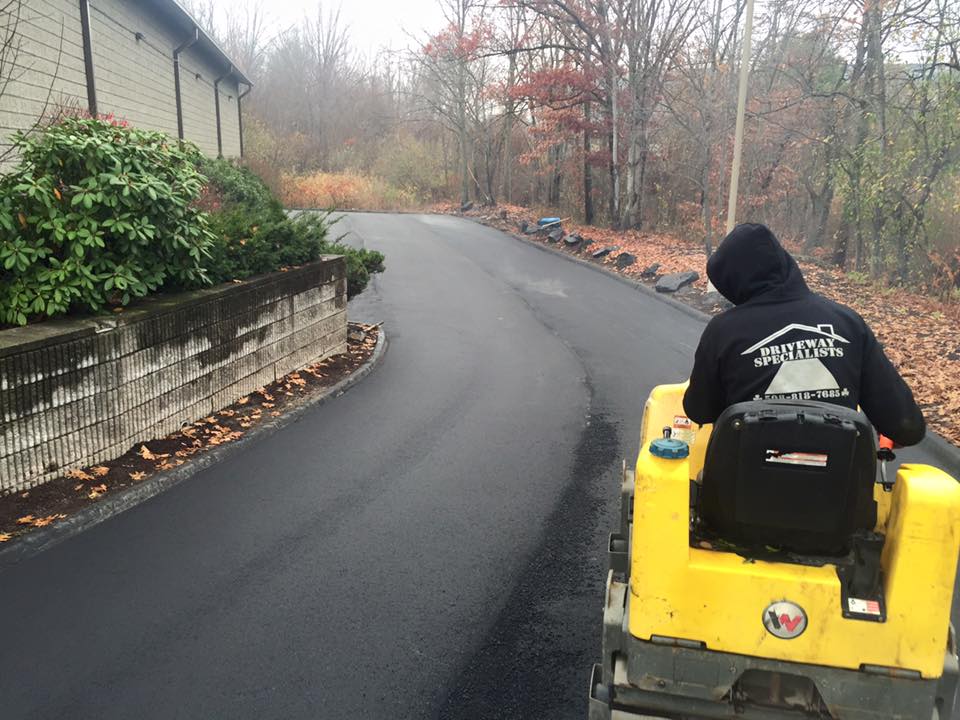
An overlay is a new layer of asphalt over the existing one. It makes sense only when what is underneath is sound.
A sound base looks like this. The surface is mostly flat and even, without dips or ruts where wheels run. The edges are intact. Water drains off the drive and does not stand on it. Where the old asphalt has broken up, the damage is on the surface and does not follow the line of the base moving.
A failed base looks different. The drive has dips and waves, or wheel tracks worn into it. The edges have slumped or broken away. There are areas where the surface has sunk and holds water after rain. Cracking appears in a pattern, with the surface breaking into sections as the ground moves under it. Laying new asphalt over that covers the symptoms. The base is still moving, and the new surface will show it again.
In that case the old surface comes out, the base is rebuilt, and the drive is paved new. This costs more up front. It is also the only version that lasts, and an overlay over a failed base is money you will spend twice.
We will tell you which one your drive needs, and we will show you why when we are standing on it. If an overlay is the right call, we will say that too.
What drives the price
Several things set the cost of a driveway, and each one is visible only on site.
- Square footage : The area to be paved, plus any widening, turnaround or parking pad you want added.
- Depth of excavation : How far down the old material has to come out, and how much of the base has to be rebuilt.
- Material removed : The old asphalt has to be hauled away, and the amount depends on what is there.
- Access: A paver, a roller and delivery trucks all need to get in and turn around. Tight Belmont frontages can limit what equipment fits, which changes how the work is staged.
- Grade: A steep drive is harder to prepare, harder to compact and harder to drain correctly.
- Drainage: If water needs to be moved off the drive and away from the house, that work is part of the job.
- The apron: On many Belmont lots the apron meets the sidewalk with very little room between the street and the house. How that transition is built affects both the drive and the walk, and we look at it closely.
Anyone who gives you a firm figure without having stood on your driveway is guessing. When the guess is wrong, the extra cost shows up later as shortcuts in the base.
The apron and the street
Schedule and weather
Paving season in Massachusetts is limited. Asphalt has to be laid warm and compacted before it cools, so the work stops when the weather turns cold, and it cannot be done in rain or on a wet base. In practice that means the good paving weeks fill up, and a driveway that fails over the winter gets booked into a queue in spring.If you know the drive needs to be done, call early. We can look at the site well before the weather allows work, give you a written scope, and put you on the schedule so the job is ready when the weather is.
What you need to do
Before we arrive, move cars off the drive and out of the way of the equipment. On a two-family house that means arranging for both households, and it is worth sorting out ahead of the day.Once the new surface is down, keep vehicles and foot traffic off it until we tell you it can take weight. We will tell you when. Fresh asphalt is soft at first, and the first season is when it is most easily marked. Avoid turning the wheel while the car is stationary, and keep sharp or heavy points, such as bike stands and the edges of ladders, off the surface. It hardens as it settles, and we will explain what to expect as it does.Edges are the part of a drive most exposed to snow plows, so we build and compact them with that in mind. If you use a plow service, tell them the drive is new.
FAQs
Can you give me a price over the phone?
No. The things that set the price are the area, how deep the old material has to come out, the access, the grade and the drainage, and none of them can be judged from a description. We look at the site first and give you a written scope.
How do I know if I need a full replacement or just an overlay?
Look at the shape of the drive rather than the cracks. If it is mostly flat, the edges are intact and water runs off it, an overlay may be enough. If it has dips, wheel ruts, sunken patches that hold water, or the surface is breaking up in sections, the base is moving and an overlay will not fix that. We show you the evidence on site so you can see it for yourself.
My driveway is steep. Is that a problem?
It changes the work but does not prevent it. A steep drive needs more careful preparation, firmer compaction and a plan for where the water goes, because a slope carries runoff along the surface and into the edges. We look at where the water comes from above the drive as well as what lands on it.
Will your equipment fit on my lot?
We check that on the site visit. A paver, a roller and delivery trucks need room to get in and turn. If the frontage is tight, we plan how the work is staged around that and tell you before you commit.
Do you remove the old asphalt?
Yes, when the job calls for a full replacement. The old surface comes out, the base is rebuilt as needed, and the new drive goes down on top of it. How much has to come out is one of the things we measure on the visit.
How soon can I drive on the new surface?
We tell you on the day, because it depends on the weather and the work. Fresh asphalt is soft at first, so keep vehicles and foot traffic off it until we say it can take weight.
Can driveways be paved in winter?
Not reliably. Asphalt has to be laid warm and compacted before it cools, and it cannot go down in rain or on a wet base. Paving season in Massachusetts is limited, so if your drive needs doing, call early. We can visit and scope the job before the weather allows work, then put you on the schedule.
We tell you on the day, because it depends on the weather and the work. Fresh asphalt is soft at first, so keep vehicles and foot traffic off it until we say it can take weight.
Do I need to be home?
It helps for the site visit, so you can walk the drive with us and ask questions. On paving day, what matters most is that the cars are moved and the access is clear.
Will the new driveway crack?
Any driveway in New England moves with the freeze-thaw cycle. What matters is the base underneath. A base that drains well gives the water somewhere to go before it freezes, which is what keeps the surface from heaving and breaking up. That is why we spend the money on the base first.